Maine-ahs In Training
Welcome to a new feature on the ALIA website! California transplants Steve Jarvis and Kate Fosselman moved to their home on Annabessacook Lake in Winthrop a few years ago; in 2025, they joined the ALIA board. Here they'll occasionally post what they've learned about lake living--in their unique conversational style--and share insights into how all of us can show support for the health of our beautiful lake.
Episode 1: "Think CLYNK!"
Steve and Kate discover how the CLYNK returnables program can benefit ALIA.
Kate: Sitting here, the lake is just beautiful! Moving to Annabessacook Lake has been sooo uplifting.
Steve: You’ve got that right. Southern California is becoming a smoldering dump!
Kate: Stop talking trash about where our kids still live! I just want the beauty here to be protected so they’ll come visit us!
Steve: I agree.... I think.
Kate: That CLYNK recycling project is one great idea. It’s a perfect way, and a really easy way, for people here on the lake to recycle and make money for the Annabessacook Lake Improvement Association!
Steve: Yeah, but what’s the deal with those stickers you have to put on the recycling bags? What good is it without those stickers?
Kate: Here’s the deal. Buy a box of CLYNK bags at any Hannaford’s. Then, email ALIA at AnnabessacookLakeMaine@gmail.com with your mailing address. They will send you the QR stickers that are set up for direct deposit to the ALIA account. Or, if you are local, the Association will gladly deliver the bags and stickers to your home. Even folks who already have an account with CLYNK can designate their deposits to the "Annabessacook Lake Improvement Association" as well. It’s a win-win!
Steve: Uh-huh.
Kate: That’s your sharp-tongued response!??
Steve: I’m busy watching the dazzling fall colors reflecting on the lake.
Kate: Oh, sure you are.
Steve: Okay, what does the Association do with all that CLYNK money?
Kate: First, it’s not that much money, but it could be if more people get involved. Some of the money goes to stop aquatic invasive species, such as variable-leaf milfoil and European frog's-bit, from taking over the lake and spoiling the water quality and those “dazzling” fall colors. Also, the Association buys the materials and builds those floating loon nests to help increase the loon population! And that’s only the half of it!!
Steve: Yeah, you forgot those navigational aid markers on the lake. The Association pays for those, too!
Kate: You know...trash can make our lake beautiful!
Steve: You sound like an ad person.
Kate: Where you going?
Steve: I need a beer.
Kate: Well, I’m walking down to the lake to act like Katherine Hepburn in "On Golden Pond"... “The loons! The loons!”
Steve: Don’t fall in.
Episode 2: "Beware of Ice!"
Winter: Kate is in the sunroom gazing out at the frozen lake. Steve is in the next room.
Kate: Hey Steve, come out here! Take a look at the lake.
Steve: Yeah, okay. What?
Kate: This is amazing! A whole family out there on ice skates.
Steve: Wow! There goes a quad towing two sleds full of BBQ stuff!
Kate: Yes, and nice and slowww. Here comes a kid on a fat-tired bicycle flying a skinny kite chased by a big fluffy snowball.
Steve: You mean that white dog?....Good lord, it’s a damn circus!!
Kate: No, It’s a Winter Ice Festival!..... I would love to be able to just take Gracie out for a little walk on the lake. But, some days I’m afraid to just walk out the front door because of the ice.
Steve: I saw you were online at maine.gov. Maine Department of Inland Fisheries & Wildlife. I found all kinds of Winter information there.
Kate: Like “Winter Ice Safety Tips”,—and for me that’s just making sure that I know how to walk on the slippery stuff. Like the safest way to walk. I'm sure everybody here knows this, but, there are two different thoughts about how you should walk. Some of 'em say that you're supposed to walk like a penguin, and that means pointing your feet out and kind of scuffle along so you don't actually take your feet off the snow or ice.—But I don't know if that's really the best idea myself. There's another group that says the best thing to do is make sure you just walk really flat-footed by lifting your feet up and straight down. Like a soldier.
Steve: I'm a little leery about stepping out on to the sidewalk to shovel. I started realizing how slippery it was, even with just my boots that I thought were good. So I sent away for slip on cleats. They slip on your boots and shoes.— And the kind I got are the kind that have steel spikes. They’re great!
Kate: What about those springy thingy things?
Steve: Oh, those things are worthless! They work in snow okay, but they don't work well on ice at all. I’m gonna stick with these steel cleats. And I know a bunch of companies that make ‘em. We haven't done it yet, but we should go for a walk on the lake.
Kate: I certainly don’t want to fall in.
Steve: Didn’t you look at maine.gov.? They have simple guidelines that are easy to remember. Think, “Thick and blue, tried and true. Thin and crispy, way too risky.”
Kate: Okay, but how thick does the ice really have to be?
Steve: Well, i read you’ve got to be aware of how the ice looks. Even if it's blue and clear, it needs to be at least four inches thick.
Kate: And that's for walking, right?
Steve: Ice fishing, cycling on those big knobby tired bikes…
Kate: Four inches. Really?
Steve: No matter what, you should check the thickness by using an auger or chisel to see that it's at least four or more inches thick.
Kate: Or, we have such great neighbors. we could just con them into checking for us.
All I know is that it looks like there'd be a lot of fun out there. I just saw some folks pull out an ice chanty for fishing.
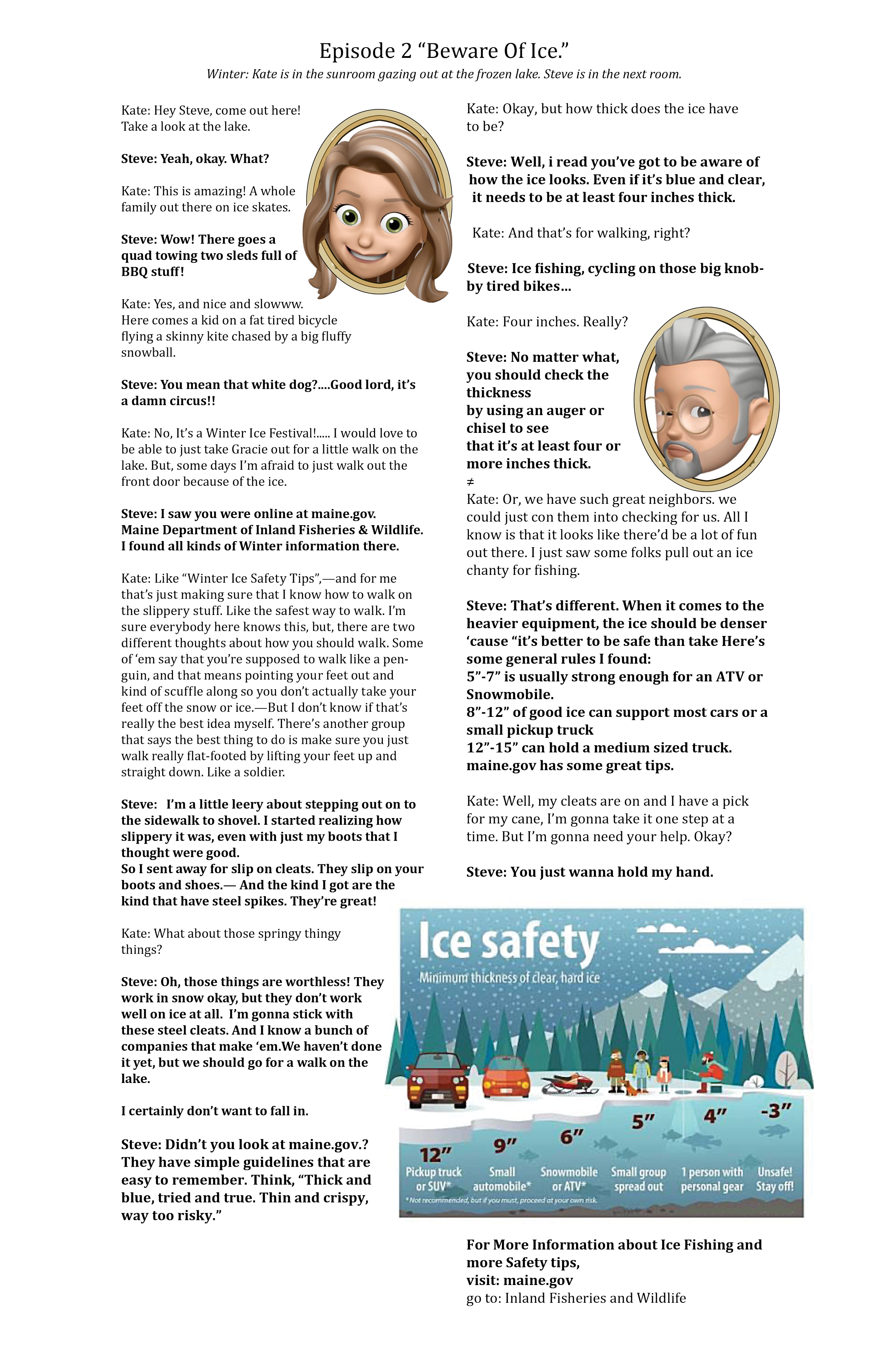
Steve: That’s different. When it comes to the heavier equipment, the ice should be denser ‘cause “it’s better to be safe than take the risk.” Here’s some general rules I found:
*5”-7” is usually strong enough for an ATV or Snowmobile.
*8”-12” of good ice can support most cars or a small pickup truck
*12”-15” can hold a medium-sized truck. maine.gov has some great tips.
Kate: Well, my cleats are on and I have a pick for my cane, so I’m gonna take it one step at a time. But I'm gonna need your help. Okay?
Steve: You just wanna hold my hand.